Analysis of a likely fraud: Grain case Eastern Europe
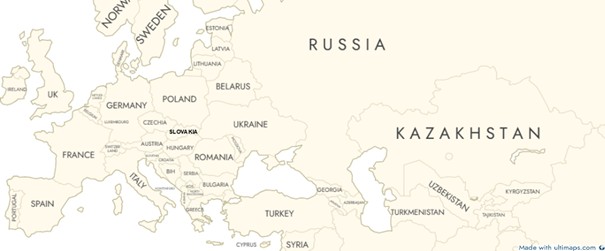
Geographical theatre for a possible fraud
Introduction
This is the write up of an AOI presentation for IOIA inspectors, early February 2024 in San Antonio, Texas. It is about a case of fraud in a supply chain involving 5 countries and 4 CBs. It was intended to give the American inspectors a taste of (potential) grain fraud in Europe, specifically Eastern Europe. Some of the wheat may have arrived in the US. There have been some big fraud cases in the US including imports of suspicious goods from Eastern Europe so the inspectors were keen to know more about that. They also wanted to test whether this kind of fraud could be better stopped by the new Rule, the SOE – Strengthening Organic Enforcement.
Eastern Europe includes the Eastern part of the European Union, i.e. Poland, Slovakia, Hungary, Romania and Bulgaria. Further east there are Belarus, Ukraine and Moldova. Even further Russia, Kazakhstan and Uzbekistan (see map above). These countries are all producers of organic grains, for export to Europe and North America. Around a decade ago there were several irregularities with grains like wheat, maize and soy. Often, these were used as feed ingredients (including sunflower cake).
There was some publicity around the 2011 Puss in Boots and the 2014 Ukraine sunflower cake scandals. Most of the cases may have been stopped, but what frustrates us at the Organic Observatory is that they are not evaluated, no lessons are learned, precautions taken, or additional measures proposed that could prevent similar cases.
This case is a bit more recent, in about 2016-2017 and in the EU. An example of a long supply chain. One question is: do these kinds of cases still happen? Are they recognised?
This article is an experiment in consideration of possibilities. The author has no evidence; it is based on hearsay. It was never a proven fraud, at least as far as we know. It is the first step in identifying contributing factors, it is one example of how a fraud may have happened, how it was solved. In a future article, more weaknesses of such supply chains will be highlighted. As happened in Eastern Europe, the same may happen in other regions, with different actors, and different CBs, but having the same or similar patterns.
Learning to detect similarities may help to have more effective inspection, and certification, and to warn buyers so that they are better informed of what they are buying.
How it was exposed and resolved
Recalling the case: a German bakery tests a batch of baking quality wheat, a standard quality procedure. A residue is found, indicating the use of a growth regulator used to shorten the stems/straw in wheat. The bakery informs its CB. The CB suspects application of a prohibited substance. The CB informs the supplier, believed to be a Dutch importer, who communicates with their supplier. There is little response. After some to and fro, the supplier takes back the contaminated lot and replaces it with a residue free one, with a similar certificate. The bakery is relieved, bakes his bread, so that is the end of the story. Or is it?
A few weeks later, several CB representatives happen to meet. They come to talk about this case during a coffee break and the supply chain and its problems unfolds. The author of this article happens to be present. No names are given, everybody acted within their role, the author hopes they do not mind my explaining the case with a view to improving future procedures.
The supply chain
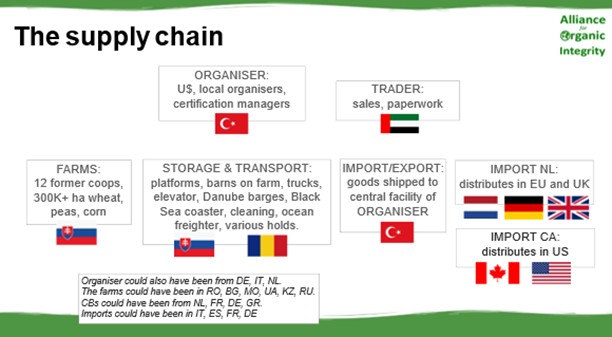
The supply chain is initiated by what is called here an Organiser, in this case in Türkiye. This company operates processing units on the Black Sea coast. It organises the supply for its factories, and finances that business.
A Local representative is appointed in the production country. That person identifies the farms, makes the deal and takes over the goods. The Local representative employs a Certification Manager (CM). That person trains/instructs the farmers on how to grow the organic wheat and takes care of the organic documentation.
Twelve farms participate, all old collective farms that are now run as companies. The farms have their own equipment for arable farming. The Local organiser provides the seeds and external inputs. Then leaves each farm to itself to grow what is ordered.
By the time of harvest, the farms are visited, organic documents updated, agreements made of where the wheat will be stored, cleaned and bagged. During the inspection, the Inspector is managed by the Certification Manager. The Farm managers, and the Agronomists do not speak English or German.
At some time, the product is collected, then trucked overland to be offloaded into a storage or directly into a barge that sails down the Danube to a Bulgarian port on the Black Sea, where the wheat is again offloaded, stored, transferred, and loaded into a Black Sea coaster. The coaster offloads at a Turkish port, the facilities of the Organiser, where it is prepared for export, to Europe or the US.
The trade is done from an office in the United Arab Emirates. The wheat is shipped from Türkiye to a Dutch port; this is the first point of entry into the EU. Then distributed in Europe, including to the bakery in Germany.
It is not known whether the wheat is transported as bulk or in big bags from the start.
It is clear that traceability is difficult to maintain when wheat from different fields per farm is transported with wheat from 11 other farms, via elevators, a Danube barge, a Black Sea coaster, through a large processing facility to different foreign markets. Such trade is certainly difficult to stop when there is a late residue finding by an end user.
Investigation and analysis
Both the bakery and the importer refer to the wheat as coming from Türkiye. That is however not the Country of Origin, it is where it was shipped from into the EU. The wheat is actually from Slovakia. Not too far from Germany. Why all the transfers, why all the shipping? Why not direct trucking?
The Supplier, the Organiser, and the Certification Manager do not communicate much regarding the problem. When they do, there are denials. Like ‘We in Slovakia, the processor in Türkiye, the importer in the Netherlands have done so many residue analyses – it cannot be true that there are residues in the German analysis.’ (This was also a main argument in the Ukraine sunflower cake case). This can also be used as a delaying tactic and a way of sowing doubt.
On review, what emerged were the following facts, claims, allegations, assumptions and actions that might have triggered earlier red flags:
· That the batch of the German wheat is traceable back to a wheat field on one of the twelve farms. Is this really likely?
· The CB that certified the 12 farms had for some time already had problems with the not so cooperative Local operator.
· The Italian certifier wants the farm manager, the local organiser, and the UAE trader to embargo the wheat from the specific farm. The Certification Manager states that trade cannot be suspended, or stopped, nor the product recalled.
· The Italian CBs states that it is already for some years at odds with the Local operator, who is slow or not closing Non Compliances.
· While the Organic System Plan said that product from each field is kept separate, the farm manager said during an interview – where the CM was absent – that wheat of different fields is mixed. There is limited storage capacity on the farm, all silos need to be filled up.
· The Local organiser is adamant that one sample with a finding is not enough evidence of application of a prohibited substance. The CB’s sample taking and handling is questioned (was it really witnessed, were samples exchanged?).
· The Italian CB intends to suspend the one farm. It is threatened by the local representative of the Organiser with legal action. In the end the Italian CB cancels its contract with the Organiser.
· It is believed that all wheat of the farm(s) is marketed in Europe or elsewhere. Remember, there is no evidence of fraud, only one analysis that showed a prohibited substance. And a change of certifier. Indicators, not more.
· The CB at origin has no or little information of the routing, of the final destination of the product. When doing mass-balance it sees only a local piece of the supply chain. The certifier of the bakery has no idea of the origin or the routing either.
The CBs involved
The cluster of Slovakian farms is certified by an Italian CB. The transport, and the transfers are controlled by a Turkish CB. The import, cleaning, and preparation for export in Turkey is controlled by the same Turkish CB. It did not become clear whether the UAE sales office was certified.
The import into, and distribution in EU countries involves different domestic CBs. Fortunately for this case to be exposed, these CBs were on speaking terms and met by coincidence.
After the exit of the Italian CB, the certification of the farms is done by a Greek CB. It is not known whether they investigated the history with the Italian CB. It is not known whether the (lawyer of the) operator allowed the CB to leave behind some NCs.
The certification of the Turkish facilities is later done by another CB, believed to be from the US. CB hopping is a feature.
Main finding: This case is a good example how informal exchange helps in understanding how fraud happens. Could exchanges of experiences during coffee breaks be a training requirement?
What more could be learned from this case?
Coming up next month
In the following article next month, the actors, and the practices in this kind of supply chain will be further analysed. Also, the complexity of such supply chains, which deserves better understanding.
There will be chapters on the ownership, typical farming practices, and trading practices.
The idea is that readers note for themselves what situations should preferably be avoided, what aspects should be better looked into and what can be learned from such cases that leads to a heads up on this or that practice seen during the (preparation of the) inspection. Decertification or even delay during investigation due to problems in the supply chain can be a costly business.
The next article will have much more on indicators, Organic Critical Control Points, how such (a suspicion of) fraud can be detected earlier, dealt with when suspected, or prevented by routine inspection practices.
Bo van Elzakker can contacted at elzakker@alliancefororganicintegrity.bio
This is Bo himself. Just to test whether a comment comes through.
Wonder a little whether this is not too abstract for the average reader, can they visualise the situation, accept that it might be this complicated, with such an easy solution (replace batch with residues for batch without residues)
Hi Bo, your comment did come through. Thanks. David