
Case studies on investigating pesticide residues in organic products

by Tom Nizet, Bio-Engineer
In August 2024, a group of experts published a guidance document that centralised existing, albeit scattered, knowledge and introduced important new insights for investigating what causes the presence of pesticide residues in organic products. The publication is available as “ A Vade Mecum on Official Investigations in Organic Products.”
Since its publication, the Vade Mecum has been translated into French, Bulgarian, German and Ukrainian, and is available, free of charge, on the following website: www.organic-integrity.org
During Biofach 2026, some of the authors presented case studies that demonstrate the positive impact of the Vade Mecum to guide investigations and to determine “source and cause”, as requested by the EU organic Regulation.
In this article, two of those cases are described and illustrated.
Case 1: Imazamox in organic sunflower cake
Sunflower cake is a by-product from sunflower oil production which may be used as “organic feed”. During two inspections at a processor in Ukraine, a lot of organic sunflower cake was subject to the traceability and mass balance check as well as to sampling by the inspector of the certification body. The laboratory analysis of both samples showed the presence of imazamox in 0,024 and 0,023 mg/kg, a substance not authorized in organic agriculture. After receipt of the laboratory reports, the certification body started the official investigation, and both lots of sunflower cake and sunflower oil produced from the same lot of raw material (sunflower seeds) were provisionally blocked without any delay. The certification body asked the processor to investigate both residue cases and explain the presence of the not authorized substance.
Imazamox is a systemic herbicide. It may be used after sowing to control weeds in fields cultivated with sunflowers. It works against Orobranche cumane, which is a common weed growing in the area where the sunflowers have been cultivated. It’s important to take note that only special hybrids of sunflowers are resistant to imazamox.After an unannounced inspection at the processor, the inspector concluded that neither commingling nor contamination of the batch happened during the processing of the sunflower seeds. The processor only managed organic products since the start of the activity.
The exchange of information between the certification body of the processor and the supplier of the sunflower kernels, showed that the farmer received a derogation for the use of non-organic sunflower kernels. The variety was known as a hybrid from Syngenta, known to be resistant for so called “clear field” technology, which means resistant to imazamox. The sunflower producer explained the need for this variety because neighbouring farmers were applying the clear field technology and there is a lot of drift.
The Vade Mecum contains a list of 17 possible sources for the different residue cases. These 17 sources are the result of the screening of numerous investigations and may be considered as an exhaustive list.
As a first step, the investigators eliminated the irrelevant sources for the specific case, and 5 possible sources have been identified. One of these is a mistake at the level of the laboratory. This has been excluded without further investigation because two samples have been analysed by the same lab.
The aim of the investigation is to collect information which can be used in favour or against each of the relevant (4) possible sources. The overview matrix contained the following information:
Possible relevant source(s) | Hypothesis | Information in favour | Information against |
Use of imazamox by the farmer | Probable | -use of the special variety (hybrid) -area of cultivation is characterised by the presence of Orobanche Cumana |
|
Spray drift of plant protection products from neighbour fields | Possible | -low concentrations -found in the cake, not in the oil | -buffer zones are in place |
Commingling /mixing with non-organic products (post-harvest) | Possible |
| -processing of 100% organic products only |
Cross-contamination during processing or transportation | Possible |
| -transport organised by the processor -all precautionary measures in place are appropriate and proportionate |
Further investigation showed that the farmer did purchase herbicides containing imazamox, but did not show this to the inspector. In addition, documents to justify the purchase of the sunflower seeds had been changed by the farmer, allowing to conclude that the non-organic sunflower seeds had been also treated with non-authorized substances.
The certification body concluded that the source and cause for this case were the intentional use of prohibited substances by the sunflower producer, and downgraded the affected sunflower cake and oil; also the certification body of the supplier confirmed that the lot of sunflowers seeds has been downgraded.
Many thanks to Sergiy Galashevskyy from Organic Standard, Ukraine.
Case 2: Phosphonic acid in organic ginger
This case aimed at identifying the source and cause of one of the most often detected active substances in organic products: phosphonic acid. The particularity of this substance is that it is a so called “multi-source” substance. This means that its presence can be due to a multitude of possible sources, ranging from:
i) prohibited use of plant production products with the purpose of stopping fungal infections of plants,
ii) historical presence in soil due to use prior to the conversion period,
iii) the authorised use of non-organic untreated grafting material for perennial crops,
iv) the unknown (unlabelled) presence of phosphonic acid in fertilisers, either inevitable because of the authorised use of conventional algae or unauthorized because of mixing of compost with unauthorised plant protection products.
On the one hand, the presence of phosphonic acid in organic products may be due to situations that do not represent a violation of the organic production rules, but on the other hand, there are also conventionally produced products which do not contain phosphonic acid. In other words, determination of the source of phosphonic acid in organic products is usually a very complicated activity. Typical amounts vary between 0,03 to 0,10 mg/kg.
Inspired by the Vade Mecum (Chapter 5), the certification body (DE-ÖKO-039) started its investigation by verifying the information received, and concluded that:
i) further investigation is relevant because ginger plants are known to be sensitive to fungi attacks,
ii) the presence of phosphonic acid is reliable and
iii) detailed information about the sampling has been documented.
In a second step, the so called “long list” of possible sources has been used to differentiate between the sources which can be immediately excluded and the remaining ones. As a result of this desk analysis, 8 of the 17 possible sources have been excluded.
In a third step, still based on a desk analysis, the certification body has identified indicators which could be used in favour of the remaining possible sources. In the Vade Mecum, the authors also encourage investigators to identify indicators which can be used to reduce the likelihood of one or more of the remaining possible sources.
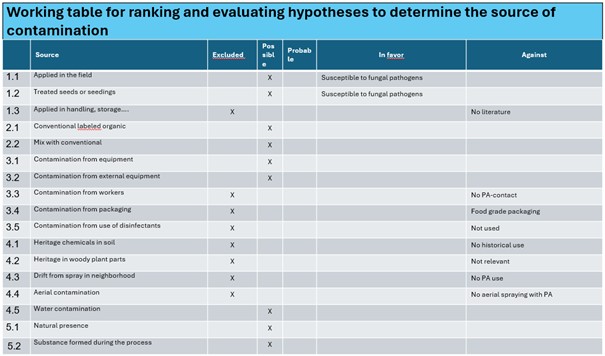
To further shorten the list of possible sources, the certification body carried out:
i) on-site inspection visits,
ii) additional sampling and testing and
iii) an assessment of traceability and the precautionary measures of all operators involved in the supply chain.
The ginger field visits did not allow to (visually) identify any application of not authorized substances. Field samples (fresh ginger, leaves, soil and planting material) from three farmers have been analysed for the presence of phosphonic acid (and other prohibited substances which are not further discussed here). Analysis of fresh ginger from the field visits showed no detection of phosphonic acid. Soil samples from two farmers contained non negligible amounts of phosphonic acid.
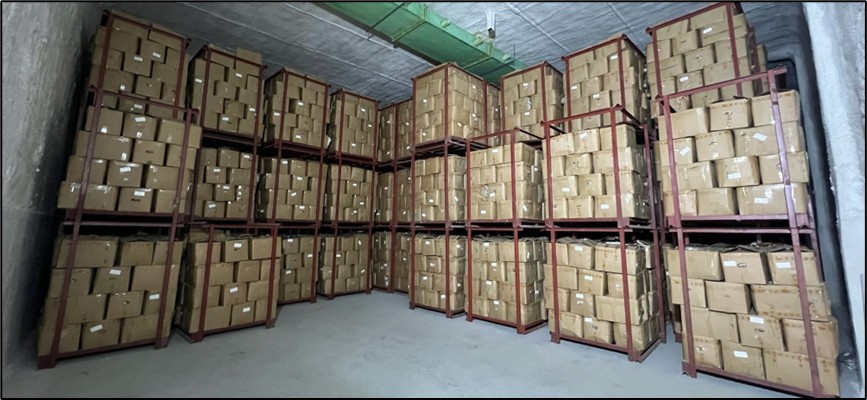
- The analysis of the samples taken during the inspection visits to post-harvest facilities did not result in detection phosphonic acid in the ginger, but it has been detected in the dust present in the storage areas used for both conventional and organic products.
The analysis of the cow manure also resulted in the detection of phosphonic acid.
The certification body concluded its investigation with the identification of a mixture of commercial fertilizer and compost as the source of the phosphonic acid. The presence of the phosphonic acid in the ginger is explained as the result of the use of compost, which has been mixed with a commercial fertilizer that has been certified as “authorised for use in organic production” by the compost producing facility.
The varying concentrations of phosphonic acid in the ginger were explained by the heterogeneous mixture of commercial fertilizer and compost.
The cause was intentional use (by the compost production facility).
The three take aways (lessons learnt) from this case are:
· Process based samples (leaves, soil, inputs, …) are very useful to determine source and cause of a contamination
· Crops which are characterized by unexplainable production patterns need to be investigated by including inputs as well
· Certification of and claims on inputs as regards “authorised for use in organic production” need to be investigated too.
Many thanks to Dr Jochen Neuendorff from GfRS (DE-ÖKO-039)
Thanks to Samanta Rosi Bellière for reviewing this article.