March 2026 – TOS issue 205 Article 1

HOW REGULATORS ARE FACILITATING TRADE: ORGANIC PRODUCTION STANDARDS AND CONTROL SYSTEMS IN SRI LANKA, MOROCCO, TUNISIA AND INDIA

by Tom Nizet, Bio-Engineer

Logos of country organic schemes
Introduction

In 2024 and 2025, I had the honour and pleasure to work in 4 non-EU countries to facilitate international but also domestic trade of organic products.  This article describes some elements of the development in the context of organic production.


Two countries, Sri Lanka and Morocco, have organic legislation but neither of these is currently recognised as equivalent to the EU. Two others, Tunisia and India, have organic legislation in place which is partially recognised by the EU as equivalent. Each of these four countries worked independently. This article is a written version of the presentation given by each country at Biofach 2026.


Sri Lanka

Sri Lanka is an island in the Indian Ocean, south of India. It is characterised by a tropical climate which results in rain fed and irrigated agricultural production practices. It has vast knowledge in farming practices and its products are unique in taste and aroma. ‘Ceylon cinnamon’ for example is recognised by the EU as a protected Geographical indication (PGI).


The Export Development Board (EDB) is recognised as the competent authority for organic production in the Export Development Act. This Act gives the EDB the legal powers in matters related to organic production. In July 2014, the official Gazette publication introduced the National Organic Control Unit (NOCU) as part of the EDB to ensure implementation of the control system for organic production. To that end, NOCU relies on an advisory and technical committee. To have legal powers to intervene on the domestic market, the Consumers Affairs Authority will be the second competent authority.


As confirmed by the publication of official texts, the Sri Lanka Standard Institution (SLSI) has been recognised for holding the exclusive powers to develop standards for organic production: referenced under SLS 1324. This standard has been revised in 2018 and 2025. The latter revision was based on the recommendations of a gap analysis carried out by national and international experts under the UK Trade Partnership Project (UKTP) project in view of obtaining a trade agreement with the UK. The SLS 1324:2025 contains production requirements and labelling rules, including the logo for organic production in Sri Lanka. This standard lays down production rules for the domestic and international market and has applied since 1 January 2026.


In 2024 and 2025, the existing control system for organic production has been assessed. Based on the recommendations, amendments to the existing control system have been proposed. The text is currently under revision by legal experts of the Sri Lanka Parliament. A first vote is expected before June 2026. After publication, a grace period of 12 months will apply.

Some corner stones of the new control system are:


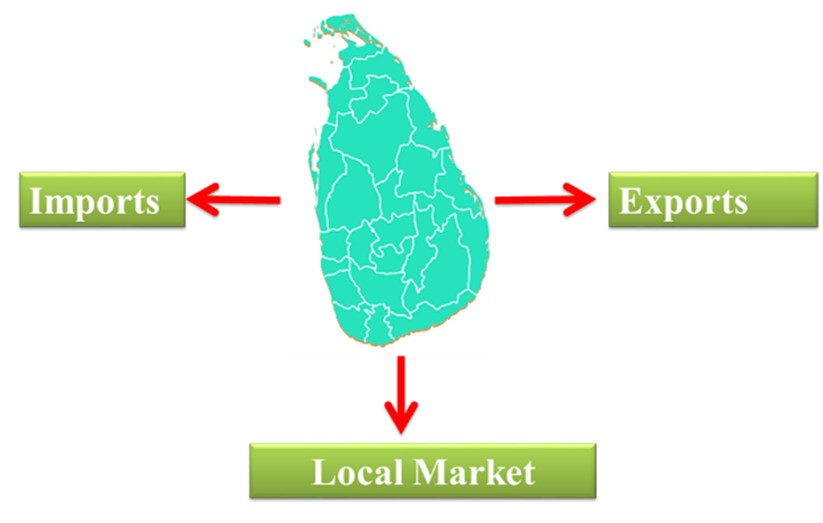
All operators, including subcontractors and clusters of farmers, involved in organic production in Sri Lanka need to be registered with NOCU. There is no distinction between products for the domestic or international market. All control authorities and control bodies need to be registered with and recognised by NOCU. One of the conditions for recognition is ISO/IEC 17065 accreditation for SLS 1324:2025 by the national accreditation body SLAB.


Next steps are the finalisation of the new control system by publishing it in the official journal (Gazette), more awareness raising among conventional and existing organic operators and upscaling of capacities and competencies at EDB/NOCU. The expected entry into force of the new control system is 1 July 2027.

Morocco

The organic sector has been characterised by important progress thanks to the Green Morocco plan launched by His Majesty King Mohammed VI in 2008. By 2020, this resulted in 10.300 hectares of land for organic production. Currently, the Generation Green Strategy (2020-2030) is in full swing. By the end of 2024, the surface for organic agricultural production has increased to 14.655 hectares and more than 350.000 hectares are recognised for the collection of wild plants and plant products.


In addition, since 2020, and driven by activities organised in the framework of the cooperation between Morocco and Germany, the Moroccan organic legislation has been adopted in the IFOAM family of organic standards.


Maroc Bio is the federation of the organic sector in Morocco which has been recognised as the official partner for the development of organic production. Multiple workshops and trainings have been organised to increase awareness of requirements for export of organic products, in particular as regards the EU market.


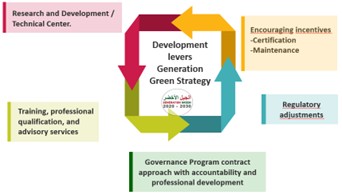
The Generation Green Strategy is based on 5 pillars.


The regulatory adjustments result in a revision of the local organic law 39-12. They are driven by the evolution in international organic standards, stakeholder consultations in Morocco, and own insights thanks to fruitful exchanges with other governmental bodies to ensure consumers’ expectations in general and for organic claims in particular.


The outcome of the recent evolution will be translated in a stronger and more reliable control and certification system for organic production. It will be characterised by increased capacities and competencies of the staff of the competent authority for organic production on all levels. In January 2026, the Moroccan Government Council adopted a new law on the creation of the Moroccan Accreditation Institute (IMA) which aims to establish a national accreditation system in line with the international standards.

Tunisia

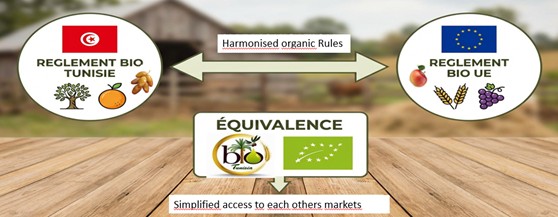
Since 2008, the EU has recognised the Tunisian organic control system and the production standard for plant production and processing of plant products as equivalent to the European organic regulation.


Since June 2021, the negotiations for a trade agreement covering organic products between the EU Commission and the representatives of the Tunisian competent authority Direction Générale de l’Agriculture Biologique (DGAB) have started. This process highlights the willingness from both parties for international trade and enlarging and widening the current unilateral recognition by the EU.


The benefit of a trade agreement is international trade of specified organic products without (additional) organic certification as applicable in the market of final consumption. The ongoing negotiations do not impact tariffs and custom duties. Under a trade agreement, organic products imported into the EU will still need to be accompanied by a certificate of inspection (COI) issued in TRACES-NT.


DGAB has designed a three-phase process:

·       Comparison of the Tunisian organic legislation Loi 99/30 with the new European organic Regulation 2018/848

·       Exchange and dialogue

·       Revision of the Tunisian organic legislation


The current Loi 99/30 covers plant production, livestock production, processing of agricultural products and the organisation of the control system. As a result of the comparison, the production standards have been revised and are in the process of publication announcing the amendments. The control system has also been upgraded.


To ensure a successful outcome of the process, DGAB has set up a technical committee and evaluated more than 1.200 requirements.


The technical committee unites representatives of organic producers, processors and exporters from all parts of the country. Particular attention was given to pesticide residue contamination and traceability of organic products. Discussions focussed on identifying the way forward in improving the existing system while guaranteeing development of organic production for the domestic market as well as for export.


The strong points of the current Tunisian system are (i) its supervision (including exchange of information between all stakeholders of the control system), (ii) the requirement for two inspections (of which at least one unannounced) of every operator each year and (iii) its harmonised enforcement policy.


The points which require further work and improvement are (i) the geolocation of organic production units, (ii) preventive and precautionary measures, (iii) clarification of requirements for certification of groups of small farmers, (iv) minimum requirements for the risk-based approach as regards controls (including sampling) by certifiers).


In October 2024, the legal expert (BIOREST project) proposed new draft texts to the Committee for consultation. In July 2025, the Committee provided its written feedback.


Currently, the Swiss and the British (England, Scotland and Wales) have recognised the Tunisian organic legislation as equivalent to theirs.

India

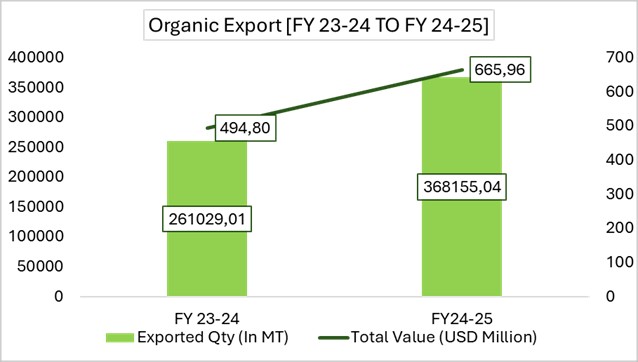
Data about exports of organic products by Indian operators show an important growth in both volumes and value.


The main export markets are the USA and the EU (respectively 330 and 210 USD million in the fiscal year 24-25).


The Indian requirements for organic production are laid down in the National Program for Organic Production (NPOP) which was launched in 2001. The eighth edition was published and entered into force on January 9th of 2025.


All organic products exported from India must comply with this version of the NPOP. In the case of groups of operators, this requires an Internal Control System (ICS) and Joint Marketing System (JMS) and thorough verification of the functioning thereof. Organic products for the domestic market also need to be produced in accordance with NPOP Edition 8, but in the case of marketing by groups of farmers, they may be certified in accordance with the Participatory Guarantee System (PGS). Organic products imported into India must comply with NPOP Ed 8 or be covered by a multilateral Arrangement (Currently, India has different types of arrangements in place with EU and Switzerland, Great Britain, Taiwan, Australia and New Zealand. with India).


The latest edition of the NPOP is characterized by updated production standards, new requirements for groups and certification of groups, accreditation requirements and inspection and certification procedures. APEDA, as competent authority for organic production in India, continues to ensure oversight and implementation of the NPOP Ed 8.

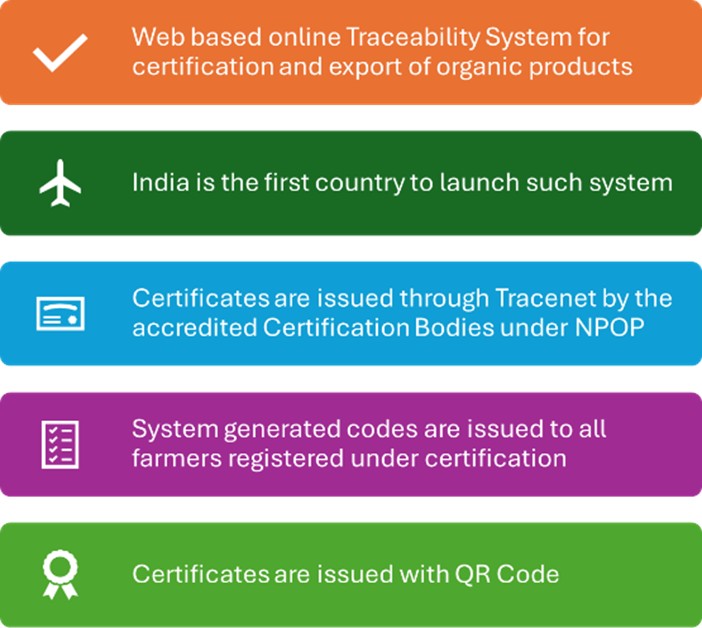
One of the important improvements in the Indian organic production system is the development of the Online Traceability System ‘TRACENET’.


The latest update of the NPOP was driven by a need for simplification, clarity and transparency. By way of example, as regards groups, the latest edition requires that the office for the internal control system (ICS) shall be located close to that of the group itself.


NPOP stands for a stronger mechanism to ensure oversight of the implementation of the requirements through TRACENET but also its revised enforcement and appeal process. To benchmark these important changes, the logo for organic production has been changed by unifying the previous logos for organic products on the domestic and international markets.


The way forward in India is characterized by enhancing capacity building at all levels, promoting global visibility and international recognition of NPOP.


Sri Lanka

Morocco

Tunisia

India

Competent authority/ies

EDB/NOCU & Consumer Affairs Authority

DDFP

DGAB

APEDA

Production Standard

SLS 1324:2025

Loi 39/12

Loi 99/30

NPOP Ed 8

Organic logo

Current EU recognition:

1.    product category

2.    origin

3.    certification body


None


None

1.   A and D

2.   Products are produced and/or processed in Tunisia

3.   as listed in Reg (EU) 2021/2325 Annex I 

1.     A

2.     Products are  produced and/or processed in India

3.    as listed in Reg (EU) 2021/2325 Annex I 

Other recognitions (for more details see relevant legislation of importing country):


None


None

Equivalence: Switzerland and  Great Brittain

Equivalence: Switzerland and Great Britain

Mutual Recognition Arrangement: Taiwan, Australia, New-Zealand (interim)

A: plants and unprocessed plant products, including seeds and other vegetative plant propagation material

D: (in this case): processed products from plants for human consumption

Current goals

Trade agreement with Great Britain

Trade agreement with the EU (A and D)

Trade agreement with the EU (A, B and D)

Trade agreement with the EU (A and D)

Challenges

Implementation of the new control system

Upscale competence of DDFP, group certification, handling suspicion of organic integrity

Geolocation of organic production units, preventive and precautionary measures, certification of groups of small farmers, risk based approach

Continued capacity building, visibility and global acceptance as organic production system


With special thanks to Mrs Vinoka PERERA from the EDB, Sri Lanka, to Mrs Rihab ZAINI from DDFP/MAPMDREF, Morroco, to Mrs Zohra BEN AMMAR from Ministère de l’agriculture Tunisie and Dr. Saswati Bose from APEDA, India.

Tom Nizet is available at:

+32 494 297 285,   OR tom.nizet@gmx.fr  

Leave a Comment

Your email address will not be published. Required fields are marked *