Triggers for organic integrity concerns
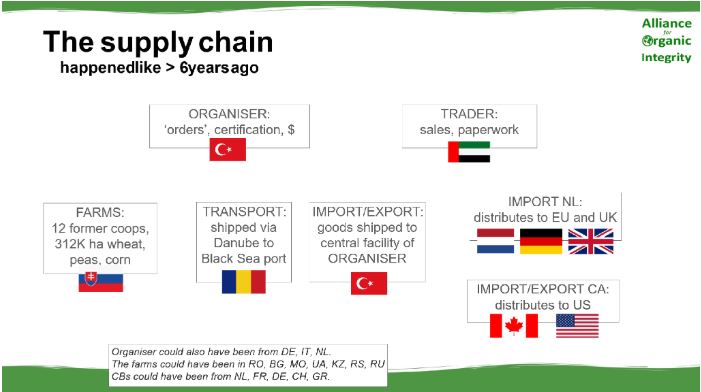
This is a paper with supply chain characteristics, circumstances, opportunities, symptoms and indicators that could be identified before in earlier cases, where there were concerns regarding the organic integrity of feed grains and oilcakes coming from Eastern Europe.
As a background, a setting, an earlier graph is given. One can easily compare that with a supply chain where the product is transported straight from the farm to a European or North American importer in big bags.
I can say in advance that the author found it quite difficult to write it up. It is much better to do this during an interactive, live, physical session. Please bear with me. I am keen to hear from readers what you don’t believe, or what I missed. And, how to do this communication better, or maybe not at all.
Awareness. Is there among the diverse actors in the supply chain, like on the farms, the storage facilities, the exporter’s and importer’s staff, in the CB, its staff, any awareness of concerns regarding the producers, the supply chain routing or the exporter’s track record? Of earlier difficulties, recurrent Non-Compliances (NCs), residues and rumours in the market. In the producer’s own operation, in sister operations or elsewhere in the country. Or is there no awareness – no interest as if it was not relevant for them – or are they/you afraid to discuss?
Business relations. In serious set-ups, there is no concern about the business relationship. They know which importer promotes the project and invests in the farm. When visiting dubious farms, the farm manager doesn’t seem to know much about the business set up. Things like where the money and the inputs come from, where the product goes to when leaving the farm, let be its final destination.
CB hopping. Is there a history of the producer and others in the supply chain transitioning CB? Are they honest – transparent about it? Are current and past NCs inherited still occurring? It happened that CBs could exit only on condition that they could not transfer NCs. Did the new CB properly consult the old CB, formally and informally? Can the inspector -and is the inspector encouraged to- contact the previous CB to hear about the problems? Were there ever unannounced inspections done, was there talk of suspension?
Certification manager. Are certification and inspection managed by an external person/consultant? Is that person holding the documentation? See Documentation.
Contracting. Is there a long term, stable relationship between the importer and the producer, with the buyer visiting the supplier (buyer audit), or is the business more speculative, with contracts made ad hoc, sometimes long after the harvest, when the market is good? Does the CB, the inspector ever get to see the contracts, redacted or not? It would be good to know the volume and quality requirements so the inspector can verify that both parameters were produced.
Is the Country – Commodity listed as High Risk by the EU. If so, what are the OFIS listings about? What is the reputation of the country, commodity, the type of supplier, the importer? But then also, is the inspector allowed by the CB to discuss with other inspectors with East European grains experience or is that prohibited? And is the inspector interested in checking the reputation of the operator with fellow inspectors, importers? See also Awareness, Informal communication.
Documentation not available on the farm, not in english, not in local language. It is with a certification manager/advisor, off farm, present when the inspector visits. Local farm staff are not familiar with that ‘foreign’ documentation. See also OSP.
Documentation, adaptation/falsification. In some of the troublesome farms/exporter situations there was a great flexibility to change the documents to how the auditor wanted it. They readily agreed that they made mistakes. Change of CoI, of volumes (the many transfer points) was also easily facilitated. In one case it included change of previous years field histories. Also see Farm maps. There are different versions of the same document.
Downstream traceability. When the shipment of the grains had been direct from the Slovak farm by truck to a European importer, the traceability of the goods was a lot more difficult to follow. In cases as described below, there were serious doubts about traceability being possible.
Farm maps, farm lay-out: Sometimes scattered fields, only part of former co-op lands are organic. Are the farm, the office, the input store, the dedicated equipment, the fields and the storage spaces easy to find? Farm lay-out is presented as being stable, but is also frequently changed, even retrospectively. For example, the ID, the location of the plots, the access road and the acreage. No signage. Even the farm manager may be unsure that you are in the right field. The farm map, the field history and the crop rotation are recorded separately with maybe different numbers. Neighbouring crops is sometimes old information, wind direction (risk of drift) is not indicated. Storage locations, buildings (numbers) often change. Holding capacities are sometimes not correct. Markings on previous batches stored, like BIO, may also be different from what is told before. There is quite a difference between what was instructed, planned, agreed and what happens in reality. They indeed make a lot of mistakes! How is the communication between the actors in the supply chain when field practices or storage spaces are changed against the orders.
Farm visit: how easy is it to plan the visit? Can you visit anytime, or do you have the impression that they first need to organise the documentation, prepare the staff, clean out the input storage, move non-organic product out of the supposedly organic storage, etc.? When visiting, can you easily visit the non-organic parts of the farm, the neighbours? Can you go for a leak on your own, so you can see the backside of a storage, a waste pit, peek over a wall, take a look around? See also interviews with farm staff.
Financial auditing, invoicing, seeing bank statements. Not possible. You are referred to the main office where they cannot help you either. By that time, you may meet a lawyer.
Fumigation. The need (infestation) versus mandatory obligation versus transporter own ‘quality’ management. Several times along the route. Yes and no. Both are done. Is alternative fumigation really happening?
GOAP, Good Organic Agriculture Practices. See OSP. There is often an astonishing lack of knowledge about what organic farming is. Or the person who knows is not there. More importantly, depending on the time of the field visit, there is no evidence of GOAP. There is difficult or rather no access to field records that can explain the tractor tracks and the equipment used.
Interviews with farm staff. The inspector/auditor is managed by the certification manager who says he knows everything. When you still want to talk to farm staff, they are absent, newly employed, don’t speak any English, or are instructed what to say. Are they cooperative, interested, nervous or maybe aggressive? When there is no opportunity to discuss in private to ask what is really going on, it is time to be worried.
Mass Balance. This typically fails because of the absence of part of the documentation or staff, computer problems or lack of time. Instead, you have to explain what input-output reconciliation is, what mass balance is (and why you need it), you have to tell exactly what you want and then they will prepare and provide it one week later. In one situation there was absolutely nothing available, nothing possible, until the consultant/certification manager came and all relevant information was presented one day later.
NC. Some obvious NCs are not identified. Is the inspector aware of the OCCPs, of the likely NCs in that kind of farms, kind of set ups, prepared? With NCs that are identified, Critical Action Reports are not understood, not agreed upon, it is not possible to change, there is no money, they are not sure of continuing the business when the inspector is so difficult, NCs are not closed or seemingly closed and re-opened next year. Sometimes solutions are not appropriate. Remember the tine weeders of the wrong width.
Organic System Plan. There often is no OSP, or only the certification manager knows about it. That one is in English. There is no document in the local language, no or vague awareness of its content among the guys on the farm, there is no relevant planning, no budget. Following up, there are no records of inputs ordered/paid/received, i.e. no inputs in storage, no instructions to tractor drivers. There is no field application seen, no photos made, no empty packaging, no financial records and no reporting. There is no evidence of GOAP, of approved input use. Organic is best defined as residue free. There may be talk about the use of manure from the animal husbandry unit, even when that operation has stopped, the manure never composted (check Google Maps over the years), the quantities are too little, the distances are too far, the equipment to transport-distribute ‘compost’ is obsolete. The organic farm may not be involved at all in producing animal fodder for the local animal unit, even when that would be a healthy organic practice. It is for export of feed grain only. The bad farms.
Price differential. Farms are price takers, they are paid a fragment of world commodity price (also because the input provision and marketing are with the organiser). In some cases, when no market was found (because of the price being too low), the farm had to sell off a pretty old stock locally. In another case, the producer could not meet a late order for a product they didn’t have enough of, and the farm decided to restock with residue free product so that it could deliver. That price was very good!
Quality testing. Is quality testing done (of course)? Are the results available for the inspector, so one can see that the products are fulfilled? Or are they of a higher quality (bread wheat), or need to be upgraded (with other organic of course).
Records. Field records, harvesting records, storage records, transport records and weighing slips are absent. The easy excuse is that this documentation was taken away by the Certification Manager. There is a continuous sense of non-transparency. Unwillingness to show, a fear of showing the wrong things. An aggressive reaction when you want to know too many points that are apparently secret.
Residue testing is likely done by the producer, the certification manager, the sales manager or by independent surveyors for the importer in the field. In the storage, when loading for export, it is done by the importer upon arrival, by different laboratories (waiting for the best result). Products mixed with other organic or conventional products are stored longer, expecting residue levels to go down. There may be elaborate policies to make sure that the product is residue free when importing. CB sample taking – analyses may be 1 out of the 10 samples taken by the operator and the buyer. In case of residue finding, is blaming drift still the standard excuse?
Risk management. What are the producer’s and certification manager’s risk analyses, what are their mitigation strategies? Is some of the risk mitigation in the OSP, is that ever actioned?
Supply chain. Is a diagram available somewhere, a plan, the reality? There is a lot of improvisation. Does the importer know, before or after the sales? How is the communication, is there communication up and down? How is it guaranteed that critical information is shared on time? I experienced once that a certain volume was sold 3 times as the different sales guys (focusing on their own markets) did not inform each other of their progress. It then had to be delivered. Is there communication, trust among actors in the supply chain, or is there fear? The sales guys may be competing, striving for maximum bonus.
Tractor drivers. An important but often overlooked source for awareness of activities, the field’s organic ID. Are you aware of recent activities? Can any tractor tracks in the field be explained, checked with tractor used? Recordkeeping?
Transport means. How is the product moved and stored downstream? Is it with 10ton tipper trucks from the combine harvester to a temporary dumpsite on the farm, heaped outside, covered/not covered till cleaned-dried, then transported with 18ton tipper trucks to a shed or moved into a silo on the farm or nearby facility. How is traceability to the field secured? When are the products from different fields mixed? How is it then transported by a larger, 36ton tipper trailer or railway cars to a next transshipment point? It is going through an elevator into a ship’s hold, how is it offloaded into the central processing unit? What goes into which silo before and after processing, separated per supplier and quality? What is the packaging until the first port of entry into a market, loose bulk or big bags? How is it stored upon entry, when is it packed in 15 kg bags for a bakery? Can that 15kg bag be traced back to a specific field after so many transfer points? While for feed it continues to be transported with 36ton tipper trailers. All stages are opportunities for refreshing CoI, for losing traceability, for involving multiple CBs, for contamination (fumigation), for commingling, for making mistakes, confusion.
Unknown operators. Quite a lot of integrity problems come from unknown operators who are invisible in the organic community. Their organic activities are kept secret, are not known by all farm staff, the neighbours do not know, other organic farmers in the neighbourhood, organic input suppliers or the local organic movement does not know. There is no signage anywhere indicating that (part of) the farms are organic. Visitors are not welcome. The operator, its staff is not participating, is even prohibited to participate in organic events.
Yields. Organic yields are often equal, sometimes higher than conventional, not only in good but also in bad years, while there is no evidence of GOAP, no evidence of use of approved inputs, maybe evidence of heavy weed infestation, for sure that is an indication that something suspicious is happening. Crop failures only exist when there is no buyer.
Did you read about these situations in the TOS 205 and 206 articles? Do inspectors of EE arable farming recognise some of it? What observations could the inspection planner, the inspector, the certification decisionmaker tick off on East European arable farms – supply chains, which indicate possible fraudulent behaviour? Could, should, and do CBs include these considerations in its risk assessment of operators, in the planning of the next inspection, during the inspection, to observe, verify a little more, to trust your own work, trust the operator? When some of these weaknesses are seen during an inspection will these be considered during the preparation of the next inspection, would the inspection planner make the inspection procedure responsive to these risks? Is some of this relevant for feed ingredients coming from other origins? Or for other commodities?
Was this a useful exercise?
Please send your comments to elzakker@alliancefororganicintegrity.bio
How to report on a case with similar characteristics without being exposed?
Thank you for your comment Nellie, anonymous complaints may be submitted to the competent national authorities responsible for organic agriculture or to certification bodies, which are required to investigate such complaints. It is important that the complaint contain sufficient information and supporting details to demonstrate that it is well-founded and warrants investigation.